
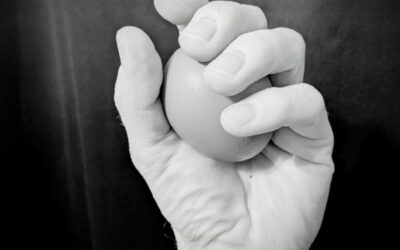
My vibrato sequence may have been a half-baked cake when I was first starting out, but I had one useful ingredient.
Yes. Eggs. Specifically, the shaker egg.
We’ve all tried this exercise with our students. But there is more than meets the eye.
I always thought the shaker egg (pill bottle, Tic Tac box) was about getting a steady rhythm. True enough. But many students can shake an egg pretty competently with approximately zero seconds of practice. I didn’t see a lot of benefit, so my vibrato sequence was egg-free for years.
Vibrato Articles
Part 1: Introduction
Part 2: Upgrading the Shaker Egg (this article)
I recently brought back the egg. And made a discovery. It’s an awesome tool … which I didn’t realize the first time around, because no one ever showed me what to look for or how those mechanics work when done correctly.
There are two fundamentally different ways to create an oscillation with the shaker egg. Unsurprisingly, the less efficient way is more instinctive for a majority of students.
Let’s take a brief tangent to weight lifting. If you were to do a biceps curl, you are working hard against gravity to raise the dumbbell. (That’s pretty obvious.) Less immediately obvious is that lowering the weight with control — rather than simply letting it fall — also uses the biceps. The lowering motion is called the “negative.”
Most students do the vibrato oscillation by engaging the opposing forearm muscles (flexors and extensors) in alternating fashion. Or at least, that’s what we think they’re doing. What’s hidden from view is that often their excellent control is coming from using both opposing muscle groups at the same time. It is like driving with your foot on the brake and the accelerator.
This is the difference between a loose, friction-less movement and one that, while well-controlled, appears stiffer and more effortful.
Which one is better? You guessed it. The effortful oscillation will never, ever gain enough automaticity to create a “concert artist” vibrato speed. The student may have the right movement, but their vibrato will be permanently stuck in second gear.
One aspect of releasing that extra muscular work relates to gravity and balance, as well as that ephemeral concept we call relaxation. There is also another secret ingredient which is soooo tiny you have to look very hard for it (and is not where you think it is). I encourage you to experiment with this on your own and see if you can identify that subtle aroma which gives every vibrato cake its effortless ease.
Looking for Suzuki Violin Lessons in Austin?
At Enchanted Wood Suzuki Studio, we specialize in guiding young beginners and their parents through every stage of learning the violin. Whether you live in North Austin, Cedar Park, or Round Rock, our studio provides a warm, structured environment where parents and children thrive together.
Ready to get started? Contact our Austin violin teachers today to learn more about violin lessons at Enchanted Wood.
0 Comments