
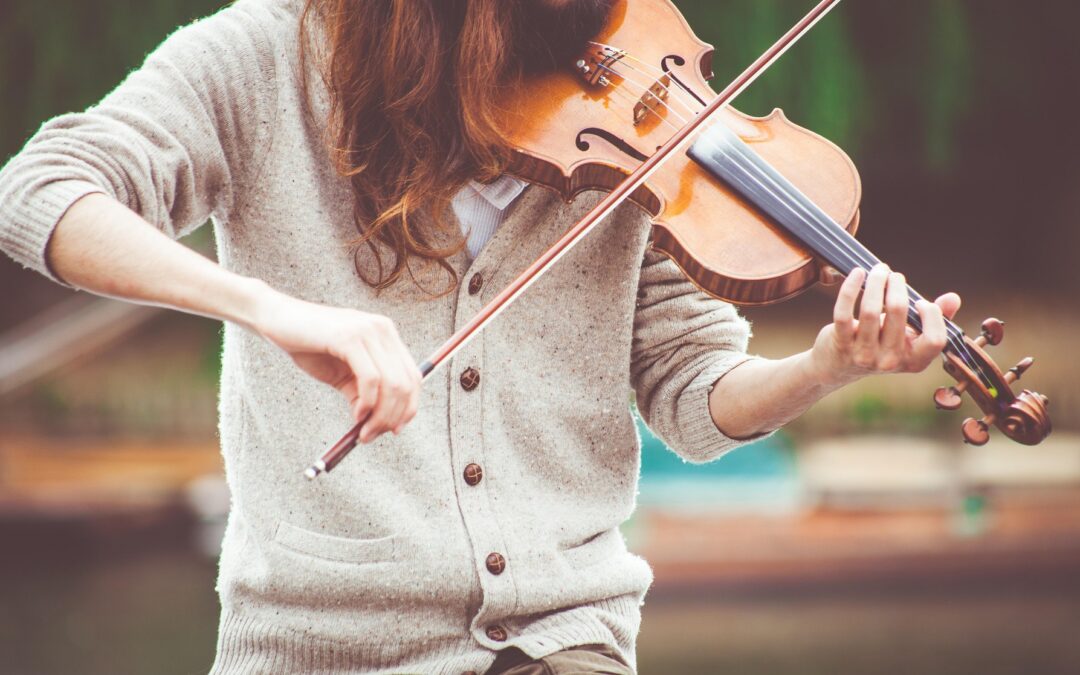
This past year I discovered that my lessons with beginners are very, very odd. Or at least, so it would seem.
This year I’ve been leading five teachers in long-term training. As part of their training, they observed several lessons a month. Midway through the year, they came to me with a request. They wanted to observe more lessons with actual beginners, instead of my advanced beginners.
A fair request. But these were my actual beginners.
So why were they asking?
Because almost every single lesson consisted of 90% physical exploration. Pinky extensions on the bow. Loooong conversations about ballistic staccato. Up-bow martelé. Detailed work on dotted rhythms with full bows. Occasionally songs – perhaps every other week, for a few minutes.
In the usual realm of beginning violin lessons, this level of reflection, detailed bow technique, and near-total lack of repertoire would resemble nothing so much as a wild-eyed, bespectacled professor rambling before a handful of wide-eyed first-years in some dusty corner of Hogwarts.
And yet, Hogwarts-like, something magical is happening. Because these first-years are rapt with attention.
The “Feel” of Violin Playing
This request from my teacher trainees was an “aha” moment for me, and a turning point in their training.
For us advanced violinists (wizards, if you will), our body is in a graceful ballet with the violin. And it is a feel thing.
But, to be clear, our own first years were not a graceful ballet. And it was not a “feel” thing.
It was:
Watching.
Meticulously.
Our bow. Violin. Feet. Finger tapes.
During our own early violin training, our body may have existed for us like a marionette with missing cords … or a half-awake airplane pilot coached by a distractible, rookie control tower operator. Or at least that’s what my body felt like. And I don’t think I’m alone, because I see it in my students in those early months.
I remember my teachers: “Don’t let your bowhold do that.”
My thought: When did it move? Whose hand is this?
So we sculpt our students into position, arranging body parts here and there to create our precarious postural masterpiece. They similarly assemble their bodies, managing and cataloguing. Keep this here. Put this there. Their references consist primarily of external artifacts. Watch my bow lane. Play it safe. Not too much bow! Observe, adjust, correct.
This creates a certain kind of playing … hopefully accurate, but also careful, stiff, and controlled. At least in the beginning. Later they transcend these constraints, but the physical and emotional tension from that early over-control takes years to dissolve.
What if there were a way to instill the graceful ballet of advanced playing early on?
Proprioception … with Tobacco and Oak Notes
Teaching posture and movement through proprioceptive exploration rather than careful control is peculiar, subtle, and strangely intimate. It is a bit like a cross between walking around town with your eyes closed and the way a sommelier talks about wine. Oak? Cured leather? Tobacco? Who can even tell these things?
At first glance, an observer of such a lesson might predict that this child must be bored. But it becomes obvious almost immediately that they are absolutely engrossed. Thirty minutes. Forty-five. Still riveted.
How? The child is exploring the brand new realm of their inner sensation:
- Finding the feeling of opening their arm … rather than watching their bow. Does my arm disappear from consciousness when I begin to play?
- Accommodating the sensation of an unfamiliar bowhold. It feels loose and slippery.
- Discovering how to move their bow arm freely. Shooting my bow rapidly and letting it fly. Enjoying the flow of my wrist and elbow.
Spending time in such open-ended explorations can seem inadvisable when the repertoire itself requires a great deal of the teacher’s attention. Even fascinating conversations must ultimately surrender to the clock, or they will slow students’ pace so much that they begin to feel stuck and unmotivated.
But what if it were possible to design students’ experience to roam freely through repertoire and unfold the inner ballet of movement?
What would it be like to teach Two Grenadiers or Seitz with grace and balance already in place?
Your content goes here. Edit or remove this text inline or in the module Content settings. You can also style every aspect of this content in the module Design settings and even apply custom CSS to this text in the module Advanced settings.
Looking for Suzuki Violin Lessons in Austin?
At Enchanted Wood Suzuki Studio, we specialize in guiding young beginners and their parents through every stage of learning the violin. Whether you live in North Austin, Cedar Park, or Round Rock, our studio provides a warm, structured environment where parents and children thrive together.
Ready to get started? Contact our Austin violin teachers today to learn more about violin lessons at Enchanted Wood.
0 Comments